What is the New Paradigm of Business?

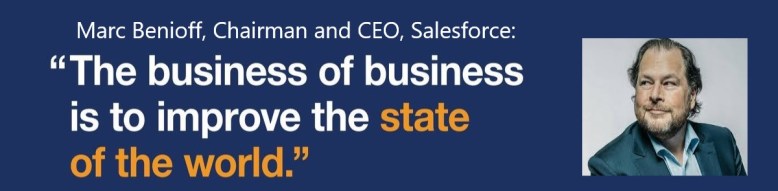
benioff quote

What is the New Paradigm of Business?

Lately I’ve been leaning toward using the term New Paradigm Business to replace Conscious Business. In either case, I often get asked “What do you mean by New Paradigm (or Conscious) Business?” I have no short answer, but the best way I’ve found to explain the New Paradigm is to contrast it with the Old Paradigm.

The following characteristics contained in the table below I think clearly delineate some the key differences between the Old and New Paradigms of business. Note that they split into two categories: Mindset and Structures. Mindset refers to the intangible ways business is viewed and experienced while Structures provides a few key examples of how the New Paradigm shows up in tangible forms and practices that support and exemplify a new way of doing business.

Old Paradigm Mindset New Paradigm Mindset
Business exists to make money; financially driven Business makes money to serve a greater purpose; mission driven
Numbers oriented, financial bottom line Impact oriented, triple bottom line
Short term, narrow focus Long term, broad focus
Maximize shareholder value Maximize stakeholder value
Zero/sum competition, dominating Win/Win collaboration, creating
Short term, narrow focus Long term, broad focus
Consciousness of scarcity Consciousness of abundance
Operating from fear and self-interest Operating from love and being of service
Left brained, analytical, partial intelligence Holistic, heart and mind integration, full intelligence
Old Paradigm Structures New Paradigm Structures
C and S Corporations, LLC Benefit corporation  (PBC)
Hierarchical organizations, top down, command and control Flat organizations, empowered, self-managing teams
GAAP accounting Triple bottom line accounting

The watershed question that distinguishes the Old Paradigm from the New Paradigm is “What is the purpose of business?” A classic Old Paradigm response is “The purpose of business is business” or in the infamous words of Milton Friedman “The only corporate social responsibility a company has is to maximize profits.” An exemplary New Paradigm response is provided by Marc Benioff: “The business of business is to improve the state of the world.” or in the motto of US manufacturing company Barry Wehmiller: “Building a better world through business.”  Out with the old and in with the new I say.

My Method for More Meaning, Effectiveness, and Satisfaction at Work (and in Life)

Image result for cut puppet strings

The following is a transcript of a speech I recently gave at my Toastmasters group:

Following my stroke I suddenly had an abundance of time to reflect while healing… which was a lifesaving, silver lining for me. One of the big questions I pondered was “What did I learn from decades of work that I found truly valuable and that might possibly be of value to others?” I looked all the successes I had over the years and distilled practices and mind states that were consistently helpful in finding meaning in work, doing it well and enjoying it more. So, in a scant seven or so minutes I’ll attempt to pass on the wisdom that it took me over 30 years to realize… at least it did not take lifetimes. This wisdom is contained in three sequential practices that I now begin each day with: Meditation 2) Orientation 3) Elevation.

#1 Meditation

I came to understand that meditation is my essential foundation practice. To me, spending time observing my mind helps loosen the grip of thoughts, emotions, bodily sensations, environmental stimuli; all the habits and unconscious responses that have me behaving like a puppet. Meditation slackens and occasionally cuts the strings and puts me in touch with my will and the power of conscious choice. It restores me to my sovereignty as a human being. It facilitates being able to bring more of my whole self to work and life.

I found that the earlier in the morning I meditate the better. Launching into the day without meditation makes me much more susceptible to “go unconscious” and react automatically and in predictable patterns. I am as motivated by avoiding the downside of not meditating as I am by the upside benefits. I found missing meditation can derail my day into a train wreck.

This quote from Buddhist monk Shyalpa Tenzin Rinpoche encapsulates the role meditation plays for me: “Meditation is not just for relaxation; its primary purpose is to develop the capacity to respond skillfully and gracefully to life’s difficulties as well as its joys.

#2 Orientation

Metaphorically speaking, meditation allows me to cast off from the dock, but it does not steer the ship. Purpose, values and intention provide the navigational system. Purpose involves a mission greater than myself. I have several: being a selfless friend to my daughter, living in harmony with my wife, and finding work that serves the greater good. Concerning values, Walt Disney said it succinctly: “When your values are clear, making decisions becomes easier”. One of my values is to be of service to others, often in mundane ways… think “chop wood, carry water”. For instance, I am currently in service to my family and community by weed wacking our steep ¾ acre, South-facing lot. The trick is staying in the consciousness of doing good while slipping and sliding on the slope under the Summer sun! Which brings us to intentions. I formulate, as much as I can, clear intentions for the day ahead. An example would be my intention to stay calm, relaxed and present… while slipping and sliding on the hillside in the heat. Everyday life provides plenty of challenge to my consciousness!

I navigate by spending time after meditation revisiting my purpose, values, and intentions. Thus, I remind myself who I really am, what is most important, what I stand for. In this manner, I start each day on course.

#3 Elevation

Keeping with the ship at sea analogy, a source of energy is needed to keep the vessel moving on its set course. I feel gaining clarity of purpose, values and intention can be an intellectual exercise unless animated by emotion. My daughter and her friends often say “I am not feeling it!” I sense what they mean is not feeling positive or elevated emotions like enthusiasm, inspiration, passion, love… emotions that provide clean burning, renewable fuel for work and life.

The technique I use to elevate my emotions is mental rehearsal. Using my mind as an artist’s brush, I paint future events in vivid detail. I become completely absorbed in my mental creation until my body follows my mind and is somatically experiencing uplifted emotions. It is the opposite, for example, of worrying, where my mind produces the hormones of stress and survival. Instead, I feel the bio-chemical cocktail of elevated emotions, the energy and the high.

In summary, I am presently engaged in daily “mind training” and gradually becoming more adept at this morning three step process of: 1) meditation 2) orientation and 3) elevation. When I look at aspects of myself before my stroke I can scarcely believe that was me! I am consciously and continually disconnecting from a past self and connecting to a future self. I can attest that you can choose who you want to be and reprogram yourself, given continuous and concerted effort.

Now, it is my hope that from listening to my practices you have derived some insight or inspiration for your own. And may your life continually move into alignment with your highest purpose, values and intentions.

 

Consciousness as Competitive Advantage Part 1: The Paramount Role of Mindset

The assertion that “consciousness” can be a competitive advantage in business begs two questions:

  • What is meant by consciousness?
  • How does it contribute to competitive advantage?

This first in a series of posts begins to answer these questions, hopefully in plain English.

To help define “consciousness”, it helps to begin by illustrating what it is not. That is, explaining how “unconsciousness” works in our lives, including the world of business.

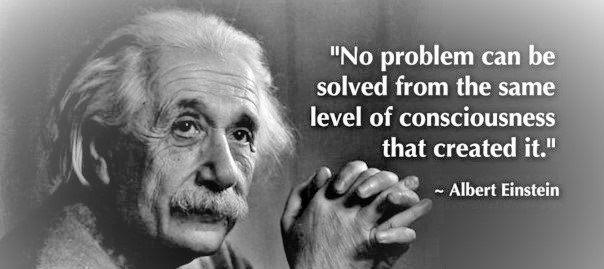
Einstein quote

Research in neuroscience contends that 95% of our behavior is unconscious. That seems like a high percentage, but makes sense upon reflection. We wake up and go through our morning routine. Drive to work taking the same route, thinking about this and that, not paying too much attention to the road because we’ve operated a car for so long that driving is hardwired in us. We arrive at work and do the same things in the same ways we’ve done them before; respond and react in the same manner. We go home and settle into another familiar sequence of habits. We go to bed only to do it all over again the next day. I believe you could say, if we really are honest, that our lives are to a great extent on “auto-pilot”.

It makes total sense that we are so habit-bound, and that is and both a positive and negative characteristic of being human. We’re habituated because it is a necessary capability to cope with the complexity of our environments. We simply can’t do everything like we were doing it for the first time. Our brains, like computers, have evolved to off-load a myriad of “programs” to run automatically in the background. In a gross neurological simplification, our lower brain centers (“reptilian” brain stem and “mammalian” mid-brain) in concert with our body can and do respond to situations without consulting with or involving the pre-frontal lobes of our cerebral cortex, the seat of conscious awareness, choice and will… the latest hardware upgrade to our biological evolution as human beings.

The problem is that we are so absorbed in these programs that we don’t even know that they are running. And when we are aware, that we have difficulty turning them off when they don’t serve us. If unconsciousness can be epitomized by an unaware, habitual, reactive mind, consciousness can be characterized by an aware, habit-free, intentional mind.

Today’s increasingly dynamic and fast paced business environment demands a consciousness that is not habit bound, sees the world in new ways, and goes beyond the known. Business has long recognized and placed premium value on the relationship of open-mindedness and creativity to competitive advantage as it strives for continuous improvement, invention  of “disruptive” technologies and development of  “out-of-box” solutions. Yet, many companies and individuals appear stuck, doing things in the same way and wondering why they do not turn out differently. My friend and mentor Dick Eppel likes to quote “All organizations are perfectly designed to get the results they are now getting. If we want different results, we must change the way we do things.” Makes sense, and to change the way we do things, I contend we have to first must occur a change in our minds (and then a change the design). To paraphrase the wisdom of Albert Einstein: “Problems cannot be solved with the same level of awareness and thinking (i.e. consciousness) that created them.”

If you are having a hard time with the word consciousness, try using the word “mindset”. They are closely related. The foundation of consciousness is awareness while mindset is the set of beliefs and way of thinking that that steers attitude, outlook, behavior and, ultimately, outcome. Mindset is also influenced by emotional states and informed by values. You might say mindset is the edifice that sits on (and colors) awareness.

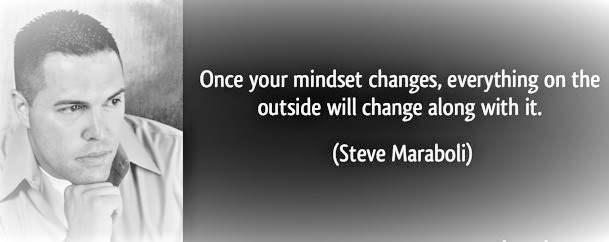
Mindet quote

It is not too much of stretch to say that consciousness and mindset are the genesis of all innovation; and that innovation is the quintessential basis of competitive advantage. Innovation (creativity) comes from open, receptive minds untethered from convention and perceived limitations.  This is just one aspect and example of how consciousness is integral to gaining competitive advantage. Following posts will explore how  consciousness operates and the various different ways it can and does directly impact competitive advantage.

Misfortune or Boon?

I originally wrote this rather lengthy blog entry for a social networking site for stroke survivors. It is offered here as an illustration of the Taoist proverb of a wise man who withholds judgment of whether events are positive or negative and waits to witness the truth of their unfolding. It tells the story of my stroke and how it changed everything… for the better.

In the pre-dawn hours of Sunday October 23, 2016, while vacationing with my family at a beach house on the sands of Ventura’s Pier Pont, I awoke and discovered my entire right IMG_1119side was asleep, uncoordinated and weak. I started to experience some panic as I realized that I was probably having or had a stroke. Keeping my fear under control, we drove off to Emergency in my daughter Amber Rose’s car. A stressed out Emergency Room doc decided not apply clot busting tPA as it was uncertain when the attack actually began; I was left to ride out the storm. Later, the MRI confirmed that I had a minor ischemic stroke in my left thalamus. In addition to my right side, my speech was also affected. 24 hours later I signed myself out to start out on the road to recovery, literally and figuratively with my dedicated wife Jean Marie driving me 400+ miles to the Kaiser Foundation Rehabilitation Center in Vallejo (to which she had miraculously gotten me admitted into). What I shortly discovered was that my old life was gone… history… unceremoniously and rudely severed. I only had a new, undiscovered life… it existed in the present and its future was unmapped.
The time from the blow of the stroke to the time I checked into rehab, about 2 ½ days, was intense. I was pretty much knocked down for the count. My entire right side was comprised, energy drained, and speech slurred. I felt like total shit, partly because my extreme hypertension was “permitted” to lessen the chance of another stroke. Every simple act took extreme effort. Although my body was devastated, my mind and spirit were not. I had the strong support of my wife Jean Marie during the crisis. I also had a substantial knowledge of neural plasticity (more on this in future posts) from being a student and practitioner of the work of Dr. Joe Dispenza. The latest research in neural science underpins his working model of human potential (condensed in his “how to” book Breaking the Habit of Being Yourself). So I had engrained knowledge and evidence that the human brain could rewire itself and adapt; that this is what it does naturally. I listened inside myself and what I heard was “You’re going to be OK.” In the hospital, I accepted my situation, began to look ahead, and started to focus on my healing.

The week in rehab jump started my physical recovery. Daily PT, OT and Speech Therapy IMG_1142did a lot for my body and brain. Being able to get right to work on recovery calmed me emotionally and gave me a sense of empowerment. The blood pressure med lowered and stabilized my blood pressure; I started to feel better. It was also a Godsend in terms of giving my wife a break; she was exhausted from taking control of the situation, dealing with hospitals, lack of sleep and a marathon drive.

As I started to feel better and lay resting in my rehab hospital bed, I began to take inventory of how the stroke suddenly changed my life. I realized that I was abruptly knocked off the treadmill of my life, completely blindsided. More profoundly, I realized how lucky I was to be alive and that the stroke was not more severe. The effect of this “brush with death” was to make each day more consciously precious. I found myself looking at things that I was too busy to pay attention to or ignored. Stroke touched every aspect of my life, I began looking at how. Moreover, I explored how I was going to live life in a way that was more meaningful and full of purpose. This has been the greatest gift, a true blessing: the proverbial “wake-up call” followed by a “new lease on life” and “living each day to the fullest”.

If some of you are probably starting to think “He’s sounding like he’s from Northern California and one of those New Age types.” And you’d be right. I went to college and IMG_1145majored in Psychology at the University of California, Santa Cruz in the late seventies and have been continually exposed to wide range of psychology, philosophy, spirituality and science related to human evolution. Those were and continue to inform my life. Mostly, a saint from India guides my life: Paramahansa Yogananda, best known for his classic Autobiography of a Yogi. Since I am married and have a kid in college, a lot of life has also been spent dealing with day-to-day practical realities like working hard, being a Husband and Father, keeping a house, and paying the bills.

I am providing this background so that you have a greater context to one way my mind shifted, which was another blessing. I had a full life based on doing and my identity was tied up in what I did. Well, I could no longer work, walk normally, drive, multi-task (not that I was ever very good at this) focus and attend for long periods (again, not that I was ever very good at this), etc. When my former identity with the external was vaporized (even though I knew my condition was temporary), I was forced to turn inward to address the question “Who am?”. This inquiry changed and is changing many aspects of my life for the better. I realized what was going on in my mind was more important than what going on “out there”. I recently watched an interview with Ram Dass, spiritual icon of Be Here Now and Timothy Leary fame in which he talks about a similar blessing in the aftermath of his devastating stroke . While Eastern spirituality teachings speaks to our True Self not having anything to do with what’s “out there”, a stroke makes that plainly and painfully evident in the trauma of the experience. Ram Dass called it “Fierce Grace”.

Out of the fire of this Fierce Grace, I resolved not only to rewire my brain to recover function, but also to use the opportunity to rewire my life… I became determined to come out better in all ways that mattered. The most dramatic example is probably the first decision I made in rehab: I resigned from my position. Although my tech employer was willing to provide Medical Leave, I informed my boss that I was heading in a different direction and that the team should go forward without me. It was really somewhat of a “no-brainer”… I was previously greatly ambivalent about my position as a “Business Development professional”, but now it was clear as a cloudless, vista view. That job was not who I am nor was it part of who I wanted to be. The nagging, minor detail of what I was going to do instead was missing, but I was confident that would come in time. I was going to reinvent myself from the inside out.